Showing posts with label Documentary. Show all posts

Tuesday, February 23, 2010

Psy-trance Culture

a. The Other

As with the rogues, the trance culture is also dominantly viewed by outsiders with suspicion and often much negativity. Thompson says he has friends who view the Trance community with much disdain and consistently point out how ridiculous the whole affair is. To test this, I decided to randomly ask people at a local pub how they felt about Psychedelic Trance. Many of the responses were much the same, in general describing the community as characterised by annoying people who waste their time on drugs.

The Chicago school of Sociology generally saw the public as being in opposition to subcultures. This is mainly because subcultures are seen as deviating from societal norms, and thus being in opposition to it (Gelder & Thornton, 1997: 2-3). Trancees feel that their culture come under constant scrutiny from outsiders. They seem to define themselves as being what the ‘other’ is not. This feeling of ‘otherness’ is emphasised by the bad press that the community have received over the years. On Friday the 3rd of May in 2003, “Die Burger” published an article “Weet jy waar jou kinders is?” (Do you know where your children are?) which labeled the trance culture as being a bad influence on the youth, promoting drug use and promiscuity. Police presence and even raids on gatherings have become a more regular occurrence in recent years. All this contributes to the people’s sense of alienation from the dominant society.

b. Organisation

The trance community displays a great sense of organisation. Gatherings are marketed well and effectively; bigger organisers such as ‘Vortex’ and ‘Alien Safari’ have an effective marketing campaign able to reach many by the distribution of flyers. Online web communities, such as 3am.co.za and bomelakiesie.co.za, have been established to offer information regarding the ‘scene’ and upcoming gatherings. Word of mouth is also used as a tool for ‘spreading the word’. The logistics that go into setting up a festival for over 6000 people are immense and much money is put into organising venues, setting up stages and managing the many people who attend.

Hierarchies exist in the community based on how long one has been part of the scene. This is also based on how familiar people are with the latest music in the scene and its fashion trends. As has been seen in other studies of rave culture, within the trance community exclusivity is primarily based on “hipness” (Hutson, 2000). Organisers of trance parties uphold these hierarchies through the selection of the most popular Dj at a gathering.

c. Space

A general romantic view of subcultures sees them as being nomadic and displaced, making it difficult for them to identify with a certain place. The opposing view is that subcultures have a strong sense of place and identities are formed around a fix location (Gelder & Thornton, 1997: 315). Trance culture falls into both these categories. Gatherings are held in a variety of locations, but there are some locations which are regularly used. Everyone I spoke to have their own favourite location. Oscar, for instance, is especially enamored by the Theewaters Kloof Dam where gatherings are regularly held, while Thompson recalls having his most meaningful experiences at the Nekkies Resort in Worcester. Hector feels most “at home” at the Stellenbosch Wine Farm. These locations are not owned by organisers of trance gatherings, instead the spaces are rented out, but people of the community temporarily see these spaces as their own, rather than the property of someone else.

d. Language

Trancees also have their own vocabulary. The word ‘aweh’ is used a lot and has a variety of different meanings. It can be used as a greeting, for example to replace the word ‘hello’. It is also used as confirmation, for instance, one would ask “would you like to go to the dance floor?” and the reply would be “aweh”. Another use for “aweh” would be to express happiness and well being, by exclaiming “aweh”. There are a variety of words for ‘dance’, for example “stomping”, “grinding” and “boogey” are the more commonly used. The term ‘irie’ has been expropriated from Rastafarian culture to describe a friendly atmosphere or to describe a good deed, as in “it was really irie of him to help us get the car started.” There are countless more examples which I will not go into here.

e. Technology

Technology plays an important role within Trance culture. While they do not create their own technologies, they make use of existing technology in their own way. This is especially so with Djs and producers of music. Music produced for Trance parties are made by music synthesizers. Synthesizers are often modified to produce the unique sounds that are found within trance music. The amplifiers used at gatherings are also state of the art, and ‘Vortex’ is said to be host to one of the loudest sound system in the world, reaching up to 90 kilo-watt of sound. Thompson recalls his astonishment at watching the metal bins vibrate during one gathering.

f. Economy

Within the community there is an active economy. This can mostly be seen at the stall area of a gathering where various items such as food, clothes and curios are sold. I spoke to some vendors and according to many their shops are their main source of income during the summer. They attend a gathering every weekend where they would sell their wares or foods. Prices of goods tend to be very high. For example, a bottle of water costs R20 and a ‘Psy-Trance Hoody’ would cost you R150. Selling of drugs is also very prominent within the community. Drug dealers make a lot of money, especially at bigger gatherings. I spoke to a dealer who said that he has made over R50, 000 at one gathering.

g. Master/Apprentice

In the case of master/apprentice, within the trance community this can be translated into older members introducing newer members to the Trance lifestyle. All my interviewees said that they were introduced to the scene by older members. They are all in accord that their initial experiences were overwhelming and that guidance as to how things work was very important to them. Older members would explain how certain drugs work and of what drugs to be careful, as well as acting as role models on how to approach dancing and other people.

h. Ritual

Dancing is an important activity for the community. All those who I interviewed said they feel in unity with each other and with the universe when dancing. Thompson says that after attending a gathering he can be physically exhausted to a point where he cannot even stand but that his mind has been “spiritually recharged”. Music and dance gives people at these events a sense of purpose. Hector says that at one gathering he had ‘lost’ himself on LSD, but when he started to dance he realised why he was there and who he was.

The use of drugs, especially psychedelic drugs, is prevalent within the trance community. Of all the people I spoke to, everyone is in agreement that drug use, especially psychedelic drugs, is one of the defining characteristics of the scene. Altered states of consciousness that come about from ceremonial activities (such as dancing) or through the use of drugs has long been an area of interest within anthropology. These states are characterised by a change in thought patterns brought on by slow wave patterns in the frontal parts of the brain. (Winkelman, 1986)

Studies show that there are a common set of characteristics found across cultures in regard to altered states of reality. (Winkelman, 1986)These include: alterations in thinking, change in sense of time and body image, change in emotional expression, change in meaning and significance, feelings of rejuvenation, feelings of empathy, and hyper suggestibility. (Bower, 1986)

The characteristics mentioned above are in general accordance to the characteristics described by those who I interviewed about their drug experiences. As detailed in my account of a trance gathering, both Oscar and Peterson had ingested Psychedelic drugs. Both Oscar and Peterson experienced feelings of rejuvenation, as when Oscar raised his arms in a display of Euphoria. Both subjects experienced feelings of giddiness in the initial phase of their experience, finding great delight in joking about trivial matters. In the later stages, Peterson displayed a great sense of empathy toward me as a friend, while Oscar started feeling increasingly negative toward his surroundings, yet finding a sense of comfort among Peterson and me. Both described their experience as transcending ordinary reality, being ‘shown’ a new way of looking at the world.

Thompson feels that he has reached this kind of ‘transcendence’ before without the use of drugs, often through extended periods of dancing. Studies show that altered states are often reach in non-western societies through extended periods physical exertion, as well as from hunger and thirst. (Bower, 2006) Whichever way these ‘states’ are reached, they are clearly significant to those who experience it, and in my opinion, is one of the reasons why people find meaning in among each other and in the community.

Trance Party

In my third year I did a small project on the 'Psychedelic Trance' scene which is quite big in the Western Cape. It turned out to be a really good project and I did very well, but I don't feel I really managed to capture what goes on there. In the end it seemed more like the outline for a parody than anything. I think my perspective is a little biased because Psy-trance begins to work on my nerves when I'm exposed to it for long periods of time. Here is a small excerpt from my journal for a party I went to with two of my friends who" I know to be familiar with the ‘scene’"....

C. The Gathering

We arrived at the gate where we each paid a R140 entrance fee. Security guards wearing red shirts directed us to a large parking area where we immediately parked the car. Oscar and Peterson were in hurry to purchase their drugs so they could relax and start enjoying the party. I agreed it was a good idea to get it out of the way. I was interested to see how long it would take them to acquire the drugs. Oscar was looking to find LSD, while Peterson wanted ‘magic mushrooms’. Oscar suggested we go search in the stall area as that is where drugs are more commonly found.

The stall area is a specially demarcated area for the selling of anything ranging from curios, to clothes and food. Food is very expensive, but in some cases worth the money, as with the slow prepared vegetarian curries and stews. The clothes for sale are well manufactured and are decorated with various astrological and psychedelic symbols in bright colours. Yellow, green and velvet pink seem to be the more popular colours. A common feature among the curio shops is the selling of smoking paraphernalia. A lot of the time, these kinds of shops are kept by Rastafarians.

Peterson knew the Rastas would have magic mushrooms so he approached the first one he saw. The Rasta acknowledged that he did indeed have magic mushrooms and that he was more than happy to part with it. They then openly concluded their transaction, Peterson purchasing two grams of mushroom for R100. I was surprised at how quickly the objective was achieved, but reckoned that the LSD would be more difficult to acquire. My assumption turned out to be correct as the vendors then sent us on a sort of treasure hunt, referring us to this person and that person until finally we found someone who sold LSD. By this time I had become so involved in the search, I did not keep my distance from the transaction as I did with the purchasing of the magic mushrooms. The vendor led Oscar and I through the back of the tent to an area where cars were parked facing away. He then searched a bag from the back of a bakkie from which he took out a small plastic bag with little sheets of paper in it. Oscar paid R100 for a tiny flat square.

We returned to the car where we opened some beers, signifying that the party had begun. I had brought a tape recorder and planned on ‘checking in’ every so often with observation or comment by any of us. I recommended that they should take their drugs later as it might be a good idea to have the experience during the daytime, as well as in the night. Both agreed to wait.

01: 36

We return to the car for more beers after having spent some time on the dance floor. Everyone is in agreement over the magnitude of the event. What looks to be over a thousand people are gathered in front of a huge stage decorated with banners hanging from constructed towers reaching up to 15 meters high. Most people are dancing to music which sounds like it is coming from a science-fiction movie. It is very abstract and seemingly random, but it is held together by a constant repetitive bass drum, and a pulsating synthesized bass line.

The darkness offers a fair amount of anonymity on the dance floor, and faces look vague in the ultraviolet light. This allows for alleviating any inhibition one might have toward dancing. People stomp their feet and raise their hands in the air, looking almost primal in their actions. There are visible groups dancing more closely to each other, laughing and attempting to communicate. It is surprisingly easy to have a conversation over the onslaught of sound, but holding a thought is difficult, as the music battles to be one’s focal point. Activity on the dance floor is very overwhelming.

We are glad to be back at the car. We decide to find higher ground where we can sit down and get a good view of the overall party.

02:28

We return to the car after spending some time on a hill talking and drinking. Looking down from the hill one gets a better idea of the party’s layout. The dance floor is right in the middle of everything. A little behind the floor is a long line of stalls and further on down the road is the entrance where we came in. Directly behind the stage is the parking area where Oscar’s car is parked and just behind that there is dam for swimming. To the right of the stage is a camping area where many tents have been erected. There is a constant flow of people coming back and forth between the tents and the dancing area. A bar selling alcohol has also been erected on the periphery of the dance floor.

After some time, Oscar decides takes half of his LSD square. Peterson decides to wait before ingesting his mushrooms. Oscar and Peterson take great delight in referring to themselves as Subject A and B over the tape-recorder. They are excited to be, as they say, my guinea pigs.

03:07

Oscar declares that he is starting to experience some ‘symptoms’, but is unable to explain them. He amuses himself with the tape recorder and mocks my distorted sense of ethics in attempting an experiment on him. A group of young men walk by the car, greeting us by letting out grunts and howls. Oscar bursts into laughter over the absurdity of the noise they make.

04:30

We have been alternating between sitting and dancing for some time. The music ‘got a bit much’ so we returned to the car. At the car, Oscar extends his arms in a show of happiness and euphoria. He claims to feel very content with himself, his behaviour mirroring the statement. Peterson ingests his mushrooms along with mixed fruit yoghurt. He displays some concern over the large quantity of mushrooms but with some encouragement from Oscar, he ingests the whole lot. At this point, Oscar also ingests the remainder of his LSD. We head out to the hill so the two can ‘come up’ on their drugs. Oscar says that ‘coming up’ while on the dance floor can be disorientating.

07:05

Peterson and I had spent much time sitting on the hill and talking. Oscar had gone off to dance area to hopefully find someone he recognised. Before he left, the three of us had a long debate over which mountain the sun would rise. The discussion seems symbolic of the two trying to find their ‘bearings’ while coming up on the drugs.

While Oscar was away, Peterson initiated a conversation on the space-time continuum. We are both big fans of science-fiction and enjoy talking about things like time travel. Peterson was especially interested in the implications of time travel, how if one had traveled back in time, a single choice could alter the course of the future, changing the present forever. This then turned into a discussion on cause and effect and we both concluded that thus far we were happy with the choices we had made in our lives. Peterson noted that he was enjoying the conversation immensely. He then seemed to display great empathy toward me as a friend. We were sharing a moment, and even though I was not under the influence of any drug, I had felt it also.

Oscar returned and was happy to see us. He had not found anyone he recognised on the dance floor. By this time, he was well into his experience. It seemed to me that his attitude in general had turned negative. He found the people on the dance floor to be ‘menacing’ and said that the atmosphere was claustrophobic. I recommended we return to the car, which by this time had turned into our ‘safe place’.

10: 30

The three of us are tired and want to go home. It has been a long night. Peterson is contented and continuously amuses us with his sharp wit. Oscar seems collected but his attitude toward the party and the people is not very positive. He is upset by the ‘wastefulness’ he sees and the people ‘freak him out’.

Friday, January 29, 2010

Dr Strangelove

I watched this documentary last night


I love all Stanley Kubrick's films, with the exception of The Seafarers and anything before that because I have yet to see them. I can easily say he is my favourite because no other film-maker manages to keep me fixed to the screen like he does. It has a lot to do with how they look, but also the content, themes, acting, dialogue and everything else. People say he his films are cold and sterile, 'too calculated' almost. But really he shot a shitload of film, trying all kinds of things until he got them right, so in the end it's no wonder the final product seems near perfect.

I think what makes the acting in his films so interesting is that he prepped the actors much like a stage director would prepare actors for their roles. Which means countless rehearsals before the actual 'shooting'. Another director who works similar to this (with regard to the actors) is Mike Leigh. If you haven't seen anything by him, I'd recommend 'Nuts in May', as it's my favourite :D

Here is a nice scene from it:


Nuts in May form part of the films he made for the BBC's 'Play for Today' series.

Thursday, January 21, 2010

Stellenbosch Parking Marshals

Excerpt from project July-November 2008:

The system has changed significantly since I did this project. The day marshals no longer wear red bibs, but these silly uniforms, with yellow arms that look way too hot to wear in the summer sun. The card system has also changed back to a cash system (maybe you can still use cards? I don't know).

'By 11:00 am the car park is almost completely full. The weather has steadily worsened by this time and everyone is huddled under their umbrellas or the trees to escape the rain. The weather makes both drivers and marshals more temperamental than usual, neither seem to relish the other’s presence. Drivers also do not have much time to pay tips or even give money for parking in the rain. They run in and out, leaving as soon as they can.

Some marshals fail to show up when the weather is bad. This means there is more to cover by less people, exacerbating the situation. It suffices to say that rainy days are not good days for the car marshals. The elements present a constant challenge and they make considerably less money.'

The majority of the Red-Bibs have a very strong work ethic. It is felt that what you put in, you will ultimately get out. If someone has had a bad day and income was low, it is believed that it is because they did not contribute as much as they could have. Often, drivers do not pay for their parking immediately; they tell the marshal that they will pay on return. Many return without ever paying the marshal. Some of the regular marshals do not see this as a problem. They feel that in time the money they have lost will come back to them, for instance, someone would come back the next day and give R10 where they originally only owed about R3. In one instance, a driver came back after three months and paid the marshal R100. There are however those who never pay up. As a result, the agency blames the marshals for stealing. Marshals are often blamed for things they are not directly responsible for. For example, marshals get blamed by drivers for things like the rise in parking tariffs, or differing tariffs for parking across town. They admit that this often gets them down and they feel frustrated by the treatment they receive, but they believe that a positive spirit will persevere and they try not to let these things get them down. There is also a general understanding that drivers are not always aware of the marshal's circumstances and that they are only people who go about their way.

Customer relations are generally important to the marshal. While many drivers are rude and tend to act indifferently, marshals do their best to communicate in a friendly manner. Drivers often park and walk away without putting money on the meter, when this happens; marshals attempt to get the attention of the driver. Sometimes the drivers flatly ignore these calls and as a result marshals often have to raise their voice. This can be construed by the driver as an act of aggression and as a result conflict arises between the two.

There are marshals who occupy a fixed a space if they have been known to make good money in that particular spot. Some marshals are able to make a lot of money in the most unlikely of places. These marshals value their customer relations more so than others. This further exemplifies how it is not a marshals position that determines their income, but their overall attitude toward the work and the people they deal with. For these marshals drivers are often seen as more than ‘customers’ or ‘clients’. It is not uncommon for drivers to have preferred parking spaces because of their relationship with the car marshal. Friendships are often formed under these circumstances, as with my informant John Henry who I often found smoking a cigarette and chatting with one of his regular ‘customers’. Regular customers usually give better tips than other customers. Building up a good customer relation is part of the red-bib work ethic and ultimately contributes to better satisfaction for the work they do. These relations play an important part in balancing out the negative attitudes of other drivers.

'By the end of the day, Yellow-bibs can already be seen standing on the periphery waiting to take over. There is shouting across the lot between Red and Yellow bibs. I am unable to make out what they are saying. I ask one of my informants what the commotion is about and he tells me that the one guy used to be a red-bib but has since left the employment of the agency. He goes on to relate how he never bothered showing up for work and how he is better of working as a yellow-bib because he never fit into the red-bib system.'

Yellow bibs do not work for an agency. I tried to find out more about how one becomes a yellow bib but all my sources were either contradictory or just plain vague. Some say they receive their bibs directly from a municipality office but other sources say that there is a man, known as ‘welle welle’. This man is said to have at one stage worked on the municipal council and as a result managed to procure the rights to distributing yellow bibs. But according to Philip Kleinhans who works at Stellenbosch’s toy museum, a man who has been part of the Stellenbosch marshalling system since its inception, no-one owns or controls the yellow-bibbed system anymore. It is basically a free for all; if one is able to get hold of a yellow bib and find a spot, then you are good to go.

Yellow-bibs usually take over from 17:00 when parking becomes free. They are mostly found at night in parking areas close to restaurants. They have a reputation for drinking on the job and harassing drivers. I spoke to a restaurant owner and he said his biggest problem is the yellow bibbed car marshals because they scare off his customers and he suspects that many of them are involved in organised crime. This of course does not reflect all yellow-bibs but it is a good example of the shady reputation 'they' have in Stellenbosch.

Wednesday, January 20, 2010

Classic, contemporary and curious cinema

I work part time in a DVD rental shop - http://www.klick.co.za/store.php?s=11 -it uses the DVD Nouveau name and image - but I think there is a definite independent quality to it and so far, is continuing to give Nouveau brand a good name. The response has been immense and people are going out of their way to support the place. I think a lot of people learned their lesson after the Neelsie Cinemas were closed down. We are also open to all kinds of suggestions for what films to stock. It's an ongoing project, with lots of interesting ideas for the future. The catalog system is quite esoteric at the moment. The display usually mirrors some kind of film mindmap of the person working at the time. Films are also categorised by genres, and writer/directors. Werner mentioned something about setting up mobile drive-ins and we are collaborating with local theaters to have themed screening nights.

We are also looking to expand the documentary section with more independent films. If you know of anyone that has made something or if you made something yourself, we'd be happy to stock it. Contact Hannes @ stellenbosch@dvdnouveau.co.za

Tuesday, January 19, 2010

Middelpos, Saldanha

Feb 2009

Upon entering Middelpos, one of the first things that struck me while walking through the streets, was the apparent ingenuity used in the construction of the homes. An array of discarded materials; old road signs, advertising boards, metal plates, wood and cardboard have been put together to create unique and wonderful shelters. Nothing goes unused. What we usually consider to be of no value is of great essence to the people of Middelpos. Much care has also been put into the maintenance of some of these plots; some are adorned with flowers and little vegetable gardens. Much pride is put into these homes. We often decorate our own homes as a reflection of ourselves and our sense of individualism. This is no different to the people of Middelpos, except that their access to material is considerably limited.

During the day a large portion of the population can be seen walking the streets or sitting inside and outside their homes. This is largely due to the shortage of work in the area. Most people have come to Middelpos, hoping to find work in nearby Saldana, which is home to a number of marine enterprises. Many have come here leaving their families behind. Middelpos is a majority Xhosa speaking community and many originate from the eastern Cape. Those who are able to find work here send much of their earnings back to their families. The problem is however; that many arrive in Saldanha and are unable to find work, becoming further entrenched in a cycle of unemployment. Children can also be seen playing in the streets during school hours, not able to attend because their parents or caretakers are unable to afford school fees (which are very low by middle income standards).

Alternative sources of income are often sought. Little home shops are in abundance, selling basic things, like cool drinks, bread and cigarettes. Rarely is there not more than one of these shops in sight. An entrepreneurial spirit can be seen in the various signs which draw people to the shops: advertising good prices and especially sought after items. One house advertised a soon to be opened 'baby supplies' shop; something the community is surely in of (lots of lovely little babies around!). Other shops also sell things like fruits and vegetables. There are also illegal forms of entrepreneurship.

The standard of living in Middelpos, as with our country in general, is quite unevenly spread. Iraq, an area of Middelpos, given the name because of its ongoing struggle, is considered to be the least well-off area in town. From experience it does indeed seem to be the case. As up to 13 people here have to make use of one toilet and there is little water facilities in the area. The houses here have no electricity and have little to nothing on the inside, save for a wooden bench and a table which holds a gas cooker and some plates and utensils. On the other side of town things are slightly better. Most houses here have electricity; they contain more furniture and in some cases, an electrical stove. Electricity is illegally sourced from the main electricity lines, which means that the use of more than one appliance simultaneously may cause the power to short. The better houses also have televisions, radios and in some cases, a DVD-player. The quality of living is not divided exclusively to the various areas of Middelpos. Adjacent homes, often on the same plot, can vary significantly in standard of living and there are homes with TVs and other appliances in Iraq, although in general there is very little.

It is a strange sight seeing a near empty shack with nothing but a television, a gas cooker and some pots and pans. The presence of expensive items like Radios, TVs and DVD players present a strange paradox. While many live with little to no material possessions, items like Radios, Televisions, DVD and CD players are in relative abundance. We live in a consumer driven world, and most people aspire for better material conditions. In a sense these things represent a measure of success to the people of middelpos.

Strolling through Middelpos, you can often hear loud music emanating from shacks in all directions, different sounds often compete against each other. Various styles of music can be heard from Kwaito, Reggae, Hip hop, to commercial pop music. At one point while strolling through the streets, I recognised the sounds of American rapper, ‘The Notorious B.I.G.’ - who was assassinated in late 1990s – Biggie, as he is affectionately known, rapped about life in the American ghetto (he also rapped about bitches and money).

The majority of people I spoke to feel that the municipality fails to live up to most of its promises. They require only the most basic of services, such as water, sanitation and electricity, yet these are not provided. The clinic which provides medical services is situated on the far side of town and is not easily available. The school is also said to be at an unreasonable distance from where people live. The hospital is also too far away, and in an emergency it takes too long reach it.

Most of us are aware of the hardships people face in our country, but this is rarely seen upfront, instead we see it from a distance, we read about in newspapers, we talk about it, but only from a distantiated, abstract perspective. There is hope in Middelpos, the people seem to have a good understanding of what it is they need to uplift themelves. They cannot however, do it by themselves. They know this and only seek the basic neccesities that is needed to lay the groundwork to allow them to better themselves socially and economically.

Saturday, January 16, 2010

The leader, his driver, and the driver's wife

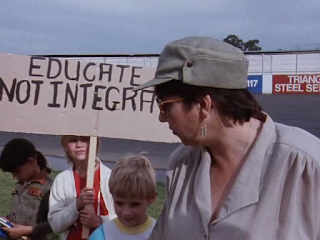
Nick Broomfield gets up close and personal with the AWB. Filmed in 1991, at the end of apartheid, he shows how the AWB start to crumble from disillusionment. His style is intrusive and comical that makes for heart warming moments in a very sad story. These 'are' good people whose hearts and minds have been turned by a history of struggle and defeat. If only they could show everyone the humanitarian spirit they show toward each other.

You can watch the whole thing online at: http://www.youtube.com/watch?v=xXmrFpu_ndw
It has a pretty good soundtrack too, featuring plenty of songs by 80s/90s SA artist, Splash aka Dan Tshanda: http://www.youtube.com/watch?v=LFApAQVac3A